

King's College Hospital: mobile signal restores control room calls
| Sector | Healthcare (NHS) |
|---|---|
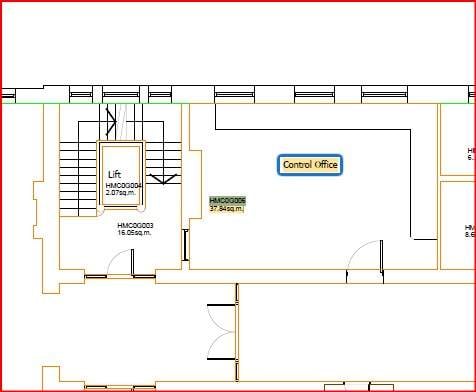
| Building | Emergency department control room in the Hambleden Wing of King's College Hospital, 37.84 m² office |
| Location | Denmark Hill, London |
| Networks | EE, Vodafone, O2, Three |
| Solution | Nextivity CEL-FI GO G43 (one unit covering all four networks, as Vodafone and Three were merged at the site) with one directional and one panel donor antenna on a roof-mounted pole, and an internal whip antenna |
| Timescale | Completed September 2026; one day on site |
| Signal | Weak → Strong (-113.3 → -76.8 dBm) |
Signal is measured in dBm: the closer to zero, the stronger. Above -92 dBm is strong; below -115 dBm is very weak.
The challenge
Poor hospital mobile signal meant staff in the emergency department control room at King's College Hospital could not reliably make or take mobile calls. A TapSurv survey of the 37.84 m² Hambleden Wing office in July 2026 found O2 almost unusable (-121 dBm), EE very weak (-115.4 dBm), Vodafone weak (-112 dBm) and Three only fair (-104.9 dBm). On the roof of the same building, EE and Three were both strong.
The solution
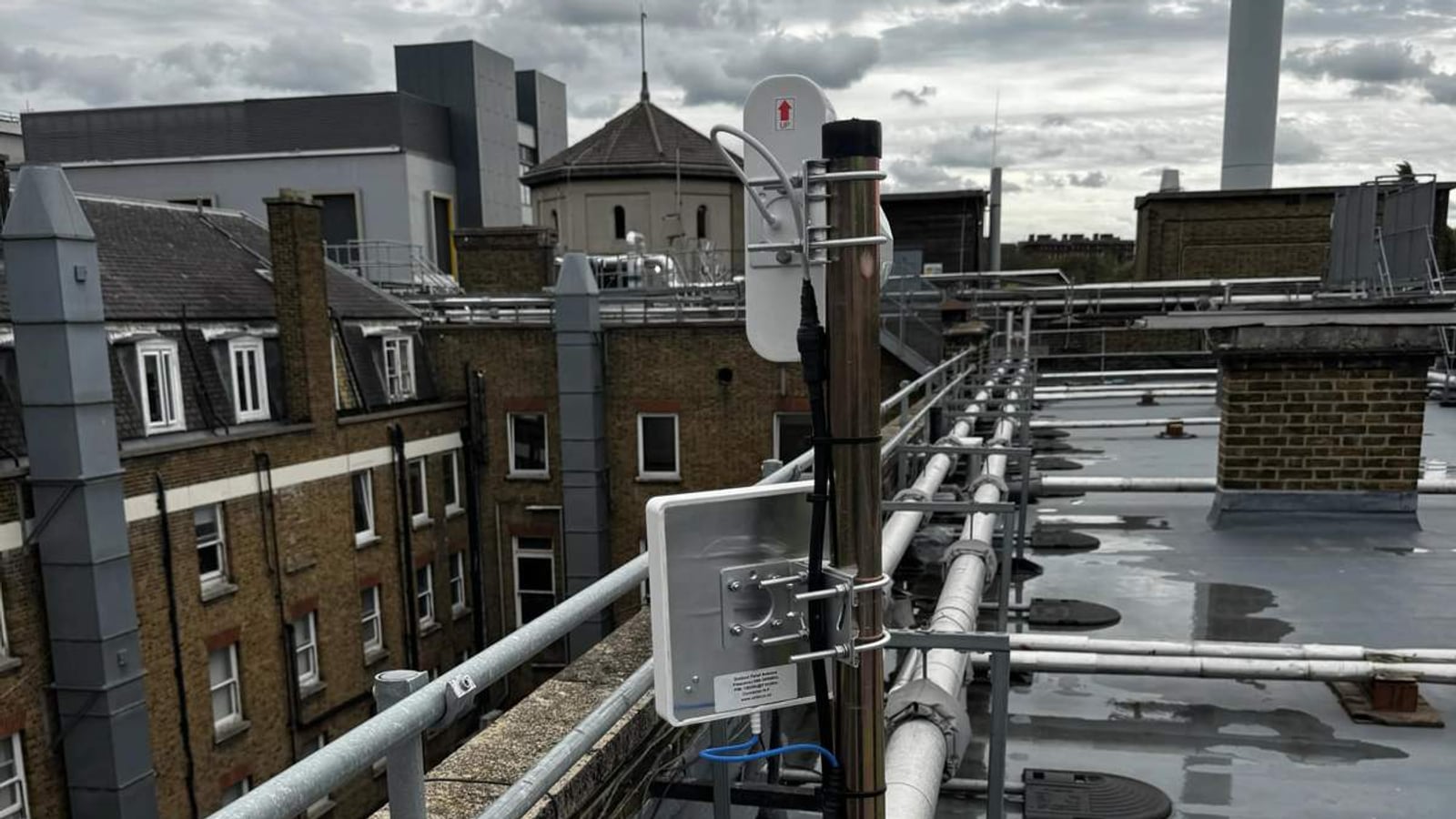
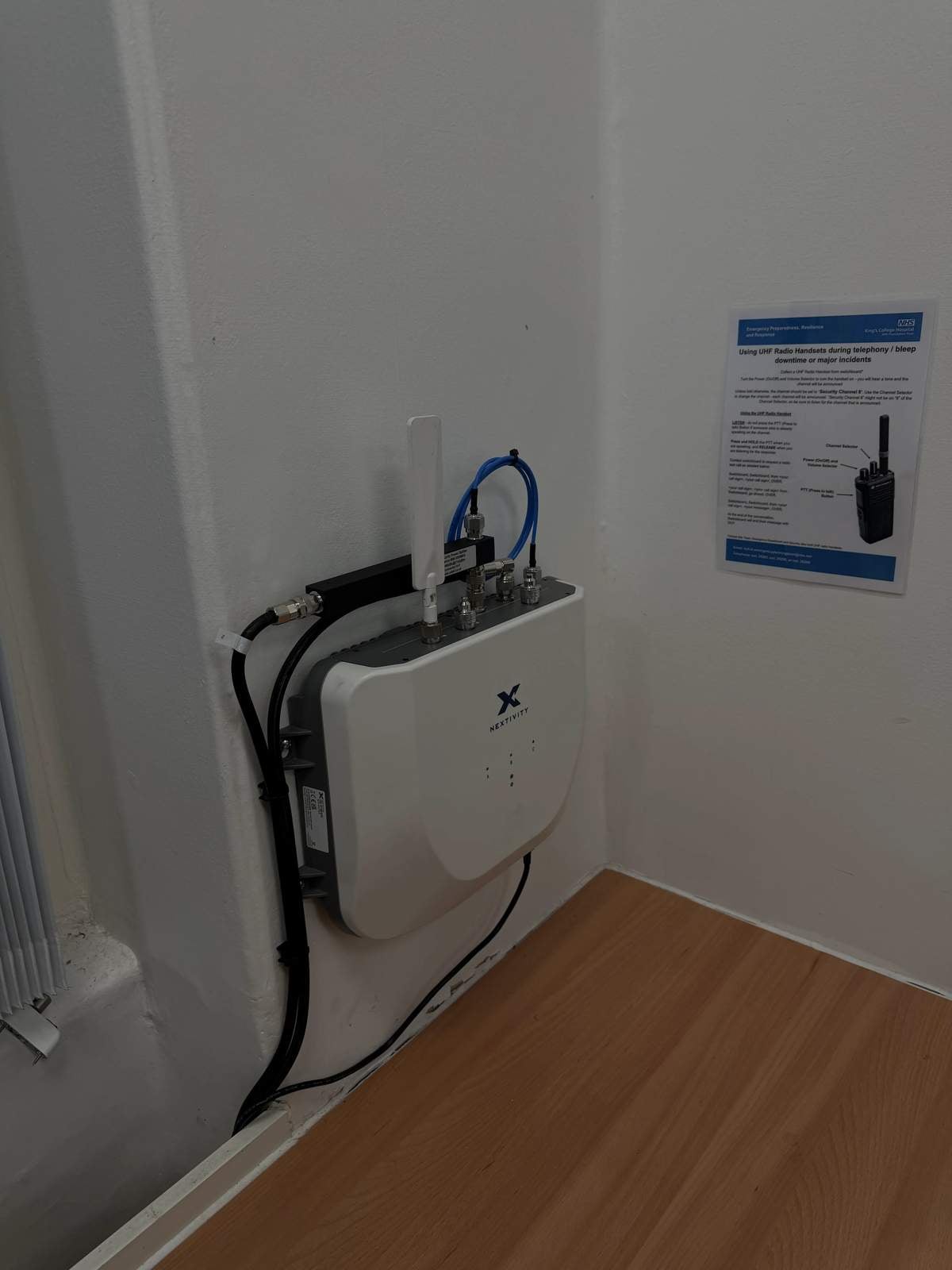
The survey showed Vodafone and Three were already merged at the site, so one Nextivity CEL-FI GO G43 could boost EE, Vodafone, Three and O2 in place of four single-network G41 units. UCtel clamped a pole to the existing Unistrut framework on the roof and fitted a directional and a panel donor antenna, weatherproofing every external connection. Cables run down the outside wall to the wall-mounted G43 and its whip antenna in the office.
The results
Control room staff can now rely on their mobiles, with strong hospital mobile signal on every network: O2 (-73.6 dBm), Three (-75.6 dBm), Vodafone (-76.4 dBm) and EE (-81.6 dBm). The work was completed in September 2026 in one day on site, and no issues have been reported since. On the day, the matron in charge said she was very happy with the signal level.