The bars and 5G Mirage: Why “Full Bars” and "5G" Don’t Always Mean a Great Connection

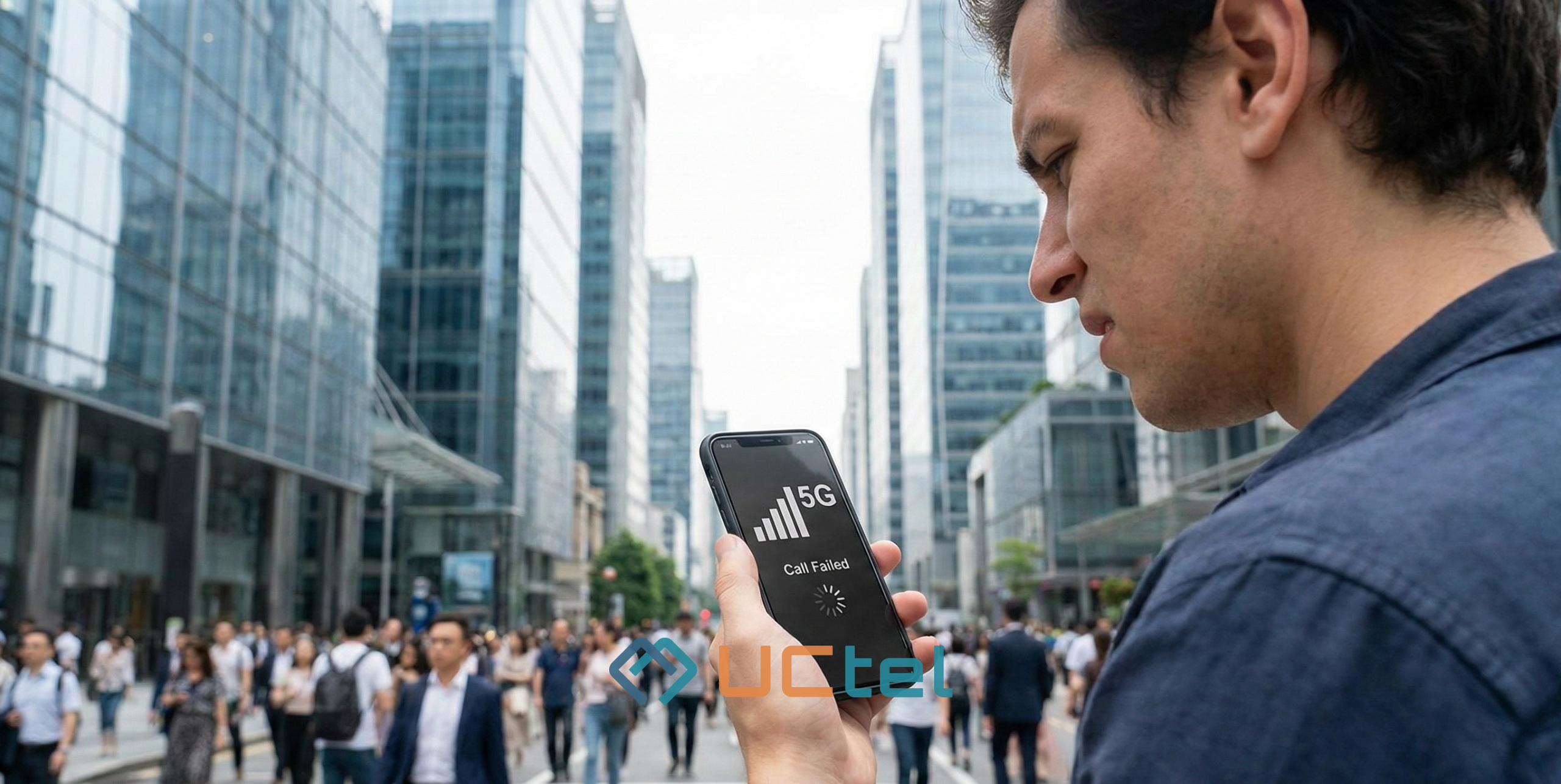
We have all been there. You are standing in the heart of a city like London, your phone is proudly displaying a 5G symbol with full signal bars, yet your call drops, the person on the other end can’t hear you, or your web page simply refuses to load.
It is one of the most frustrating paradoxes of modern mobile technology. In an era where we are promised "lightning-fast" 5G, why does the reality often feel like we are back in the days of dial-up?
At UCtel, we hear and experience this story regularly. The truth is that those little signal bars on your screen are only telling you a fraction of the story. If you are considering a mobile signal booster to fix these issues, understanding what is happening behind the scenes is the difference between a solution that works and a very expensive piece of "full-bar" wallpaper.
The Problem: Loudness vs. Clarity
The most common reason for the "full bars, no service" experience is a mismatch between signal strength and signal quality.
Think of a mobile mast like a person shouting in a crowded room. Signal bars usually only measure the "loudness" of that shout (a metric called RSRP). If you are close to the mast, the shout is very loud, so your phone shows full bars. However, if the room is filled with other people shouting (interference) or there is an echo (noise), you still won't be able to understand a word being said.
In technical terms, this is your SINR (Signal-to-Interference-plus-Noise Ratio). You can have a "loud" signal, but if it isn't "clean," your calls will jitter, your audio will cut out, and your data will stall.
The Traffic Jam: Network Load
Even if you have a perfectly clean, strong signal, you might still suffer from "capacity stalls." Mobile masts have a finite amount of "space" to give out to users, divided into units called Physical Resource Blocks (PRBs) .
In high-density areas, the mast might be at 90% utilisation. Your phone sees the mast perfectly (full bars), but the mast is so busy it simply doesn't have a "slot" to give you for your call or upload. This is particularly common in cities like London, where urban density and data-hungry crowds often push networks to their absolute limit.
The 5G "Architectural Mirage"
Another culprit is the way 5G is currently built. Most UK 5G is "Non-Standalone" (NSA), meaning your phone uses 5G for fast downloads but still relies on an older 4G "anchor" for uploads and call signalling.
Your phone might show a 5G icon simply because the 4G tower says 5G is available nearby, even if you aren't actually using it.
Why Technical Details Matter for Signal Boosters
This is where many signal booster installations can go wrong. If you install a booster and just "turn up the volume" on a poor-quality signal, all you are doing is making the "static" louder. You might see full bars indoors, but your calls will still fail because the underlying quality hasn't improved.
To implement an effective solution, you must look beyond the bars:
- Throughput Verification: Before installing a booster, we perform a site survey to test actual data speeds (throughput) at the donor point. If the speed is low despite strong signal, a booster won't help because the problem is mast congestion, not signal reach.
- SINR Optimisation: We use highly directional external antennas to "null out" interference from other towers, ensuring we capture the cleanest possible signal before it is amplified.
- Uplink Balance: Smartphones have very weak "voices" compared to masts. A professional booster has a much higher transmit power, helping your phone’s signal reach back to a distant tower.
- Regulatory Compliance: In the UK, boosters must comply with Ofcom IR 2102. Using non-compliant equipment can interfere with the network, leading to fines of up to £5,000 or even imprisonment.
The Bottom Line
Since the 3G switch off, a strong mobile signal is no longer just about bars; it’s about capacity, quality, and speed.
If your business is struggling with poor indoor coverage, don't just chase the bars. A successful solution requires a deep technical understanding of how the local masts are performing and what the available data speeds actually are.
At UCtel, we understand the "full bars, no service" challenge and specialise in installing high-performance, Ofcom-compliant systems to help overcome it. Contact us today to arrange a professional site survey and get your connectivity back on track.